
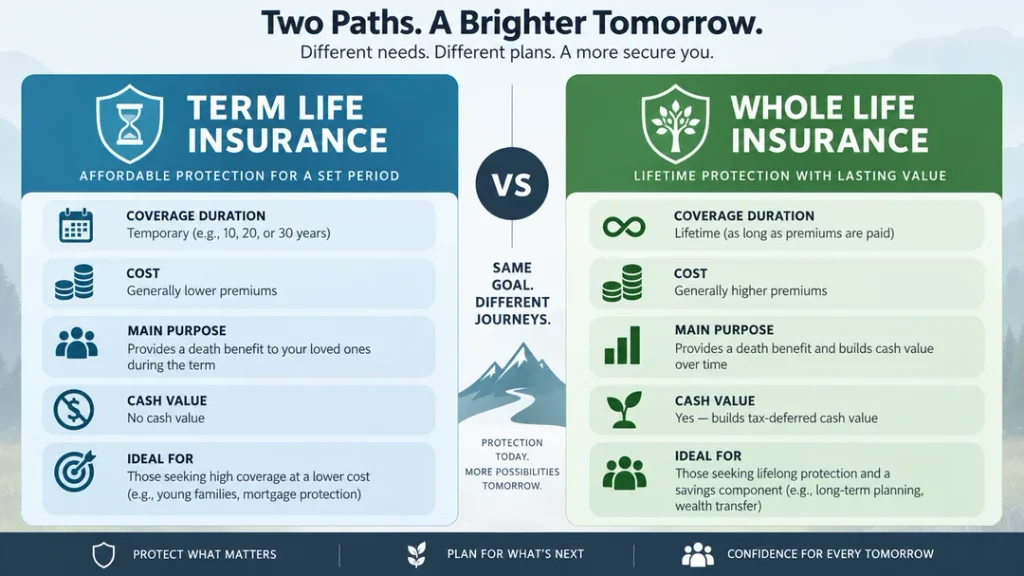
Life insurance has one job: to replace the income and pay the debts your family would lose if you died. Yet shopping for it is confusing because the two main products behave in completely different ways. Term life is temporary, simple and cheap. Whole life is permanent, includes a savings-like feature called cash value, and costs many times more for the same payout.
The right choice depends on why you need coverage, how long you need it and what else you can do with your money. This guide explains how both work, what they cost in 2026, where each one makes sense and which questions to ask before you sign. If you already know you want term, jump to our guide to the best term life insurance of 2026. If you want to compare insurers across all policy types, read our best life insurance companies of 2026.
Freshness note: prices and products change often. Figures below come from published 2026 rate analyses that do not always agree, and your own price depends on your age, health, tobacco use, coverage amount and state. Confirm everything with a quote.
The short answer
- Choose term life if you need coverage for a limited period (while your kids are young, while you pay a mortgage or while others depend on your income) and want the most coverage for the lowest premium. This fits most families.
- Consider whole life if you need coverage that lasts your entire life, such as for estate planning, a lifelong dependent or a business need, and you can comfortably afford much higher premiums.
- If you are unsure, start with term. You can often convert some term policies to permanent coverage later without a new medical exam (check the conversion rules before you buy).
Term vs whole life at a glance
| Feature | Term life | Whole life |
|---|---|---|
| How long it lasts | A fixed period, usually 10, 20 or 30 years | Your entire life, as long as you pay the premiums |
| Cost | Lowest cost for the same payout | Typically several times more expensive |
| Cash value | None | Yes, grows over time at a rate set by the insurer |
| Premiums | Level during the term, then they can rise sharply if you renew | Level for life |
| Payout (death benefit) | Paid only if you die during the term | Paid whenever you die, if the policy is in force |
| Complexity | Simple | More complex, with fees, loans and surrender charges |
| Best for | Covering a specific period and responsibility | Lifelong coverage needs and certain planning goals |
What is term life insurance?
Term life is often called pure insurance. You pick an amount of coverage (for example $500,000) and a term (for example 20 years). If you die during that term, your beneficiaries receive the payout. If you outlive the term, the policy ends and nothing is paid out. There is no cash value to withdraw or borrow against.
Because the insurer is only covering a limited window and is not building a savings component, term premiums are low. The main decisions are how much coverage you need, how long you need it and whether the policy is convertible to permanent coverage.
Pros and cons of term life
- Pros: low premiums, simple to understand, large coverage amounts at a modest price, quick online approval with some insurers.
- Cons: coverage ends when the term ends, no cash value, and buying again later at an older age costs far more.
What is whole life insurance?
Whole life is a type of permanent insurance. As long as you keep paying the premiums, the coverage lasts for your whole life and the premium stays level. Part of what you pay goes into a cash value account that grows over time. You can usually borrow against the cash value or surrender the policy for it, though loans reduce the payout if they are not repaid and early surrender can cost you.
Some whole life policies from mutual insurers are called participating policies and may pay dividends. Dividends are not guaranteed. The guaranteed growth of cash value is typically modest. One 2026 analysis puts the guaranteed growth of participating whole life cash value at roughly 1% to 3.5% a year, but check any policy illustration to separate guaranteed from non-guaranteed numbers.
Pros and cons of whole life
- Pros: lifelong coverage, level premiums, a cash value you can borrow against, and potential dividends with some insurers.
- Cons: much higher premiums, slow cash value growth in the early years, surrender charges, and complexity that makes it easy to buy the wrong policy.
How much do term and whole life cost in 2026?
Published 2026 price analyses give a consistent picture: whole life costs many times more than term for the same payout. These are examples for healthy non-smokers, not quotes.
| Example (healthy non-smoker) | Term life | Whole life | Source type |
|---|---|---|---|
| 30-year-old, $500,000 payout | About $21/month (20-year term) | About $440/month | Policygenius rate analysis |
| 30-year-old, $500,000 payout | Roughly $20 to $30/month (20-year term) | Roughly $340 to $500/month depending on age and gender | 2026 rate roundups |
| 35-year-old, $500,000 payout | About $25 to $35/month (20 to 30-year term) | About $400 to $600/month | 2026 rate roundups |
| 35-year-old woman, $1 million payout | $684 a year (20-year term) | $7,519.56 a year | Clark.com analysis, December 2025 |
Two patterns matter more than the exact figures. First, whole life is commonly four to ten times more expensive than a comparable term policy. Second, age matters a lot: a 60-year-old applying for a 20-year term can pay several times what a 40-year-old pays, so waiting is expensive.
Sources include Policygenius, NerdWallet and Clark.com.
The cash value question: what do you really get?
Cash value is the main reason people are drawn to whole life, so it deserves a close look.
- It starts slowly. In the early years, a large share of your premium goes to commissions, insurance costs and fees. Cash value may be small or even lower than what you’ve paid for several years. Ask for the surrender value (what you would actually receive) year by year.
- Guaranteed vs non-guaranteed. Policy illustrations show guaranteed values and projected values that include dividends or assumptions. Only the guaranteed numbers are promises.
- Borrowing has a cost. Policy loans charge interest, and unpaid loans reduce the death benefit.
- Cash value is not free money. If you die, the beneficiaries generally receive the death benefit, not the death benefit plus the cash value.
The ‘buy term and invest the difference’ argument
Many personal finance writers argue that most people are better off buying term and investing the premium savings themselves. The logic is simple. Using the Policygenius example above, a $500,000 whole life policy costs about $419 more per month than a 20-year term policy for a healthy 30-year-old ($440 minus $21). That is roughly $5,000 a year, or about $100,000 in extra premiums over 20 years before any investment growth.
This argument has limits. It only works if you actually invest the difference every month, and investment returns are not guaranteed and can be negative. Whole life, on the other hand, forces savings and guarantees lifelong coverage, which some people value. The right answer depends on your discipline, your goals and whether you will still need coverage after a term policy ends.
When term life makes the most sense
- You have young children or a spouse who depends on your income.
- You have a mortgage, student loans or other debts that would burden your family.
- You want the largest possible coverage for a limited budget.
- You expect your need for insurance to fall as your savings and kids’ independence grow.
- You are just starting out and want to lock in a low rate while you are young and healthy.
When whole life can make sense
- You want to leave a guaranteed inheritance or pay estate taxes or settlement costs.
- You have a dependent who will need support for life, such as a child with special needs.
- You already max out tax-advantaged retirement and savings accounts and want another tax-deferred vehicle (talk to a fee-only financial advisor).
- You have a business need, such as a buy-sell agreement or key-person coverage.
- You are older, have health issues and want guaranteed lifetime coverage, including simplified-issue or final expense policies.
Whole life is often sold by commission-based agents. That does not make it a bad product, but it is a reason to ask for a second opinion and to compare the same coverage amount across several insurers.
Other options to know about
| Option | What it is | Watch out for |
|---|---|---|
| Convertible term | Term policy that you can convert to permanent coverage without a new exam | Conversion deadlines and the types of policy you can convert to |
| Universal life | Permanent coverage with flexible premiums and a cash value account | Premiums can need to rise if the account underperforms |
| Indexed universal life (IUL) | Cash value linked to a market index with caps and floors | Complexity, fees and caps on gains |
| Group life from your employer | Coverage through work, often one or two times your salary | Usually ends if you leave the job, and may be too low |
| Return of premium term | Term that refunds premiums if you outlive it | Much higher premiums than regular term |
How much coverage do you need?
A common rule of thumb is to cover your debts, replace your income for the years your family would need it, cover big future costs such as college, and leave something for final expenses. One way to remember it is the DIME method: Debt, Income, Mortgage and Education. For example, a household with a $70,000 income, a $200,000 mortgage and two children may land in the range of $900,000 to $1 million, according to one 2026 guide. Your number will differ.
Ask each insurer for the same coverage amount and the same term length so the quotes are comparable. A calculator is a starting point; a licensed agent or fee-only financial planner can refine it. For homeowners, see also our best homeowners insurance companies of 2026 guide, and if you work for yourself, check health insurance for the self-employed.
Which one should you choose? A decision guide
| Your situation | Likely better fit | Why |
|---|---|---|
| Young family with a mortgage | 20 or 30-year term | Large coverage at a low price while the need is highest |
| Single, no dependents or debts | Often none, or small term | Little financial need for a payout |
| Self-employed with no employer coverage | Term, possibly convertible | Affordable protection and room to change later |
| Term is ending and you still need coverage | Convert, or new term if healthy | Compare conversion costs with the price of a new policy |
| Estate planning or lifelong dependent | Whole or other permanent policy | Guaranteed lifetime coverage |
| Retirement savings already maxed | Discuss permanent coverage with an advisor | May add tax-deferred growth, but at high cost |
| Over 50 and want to cover final expenses | Whole life or final expense policy | Lifetime coverage with simplified underwriting |
Which companies are worth comparing?
There is no single best insurer, and rankings change by age, health and state. Roundups of 2026 life insurers often name these companies. Verify availability and pricing for your profile.
| Need | Companies often named | Notes |
|---|---|---|
| Term life, fast online process | Ladder | Coverage that can be adjusted over time; term only |
| Term life, low rates with an exam | Banner Life (Legal & General America) | Competitive prices and strong financial strength |
| Term and permanent, agent support | State Farm | Agent network and bundling with auto and home |
| Whole life, dividend-paying mutuals | MassMutual and Northwestern Mutual | Strong financial ratings; dividends are not guaranteed |
| Seniors and final expense | Mutual of Omaha | Simplified underwriting options |
For deeper insurer comparisons, see our best life insurance companies of 2026 and best term life insurance of 2026 guides. Check each insurer’s financial strength rating on AM Best and complaint records through your state insurance regulator via NAIC.
Questions to ask before you buy whole life
- What are the guaranteed cash values and surrender values in years 1, 5, 10 and 20?
- Which numbers in the illustration are guaranteed and which are projected?
- What dividend history does this insurer have, and how are dividends used?
- What are the commissions and fees, and can I see the policy without a pushy sales pitch?
- What happens if I miss a premium or want to stop paying?
- How does the cost compare with term plus separate savings for the same goal?
- Is there a free-look period, and how many days do I have to cancel for a refund?
Common mistakes
- Buying whole life because it ‘builds wealth’ without comparing it with term and investing.
- Choosing a term that ends before your biggest responsibilities do.
- Underinsuring: many people buy a policy that covers only a year or two of income.
- Comparing quotes with different coverage amounts or term lengths.
- Waiting: premiums rise with age, and health changes can make coverage costly or unavailable.
- Relying only on employer coverage that disappears when you change jobs.
Frequently asked questions
Is term or whole life insurance better?
For most families with a limited budget, term is better value because it provides much more coverage for the money. Whole life suits specific long-term needs and people who can afford the cost.
Can I switch from term to whole life later?
Many term policies include a conversion option that lets you convert to permanent coverage without a new medical exam, usually within a set period. Check the deadline and available policy types.
What happens when my term policy ends?
Coverage stops. Some policies let you renew, but premiums jump because you are older. Others let you convert. If you still need coverage, shop for a new policy well before expiration.
Does whole life insurance build wealth?
It builds cash value, but slowly in the early years and often at modest guaranteed rates. Whether it builds more wealth than term plus investing depends on the policy, your discipline and market returns.
Is the life insurance payout taxed?
In general, death benefits paid to beneficiaries are not subject to federal income tax, but there are exceptions and estate tax rules can apply. Ask a tax professional about your situation.
Can I have both term and whole life?
Yes. Some people buy a large term policy for the years of highest need and a smaller permanent policy for lifelong needs.
Do I need a medical exam?
Many insurers offer no-exam options for term life, especially for healthy younger applicants, but they can cost more or limit coverage. Compare both.
Final verdict
If you are asking which is right for you, start with a simple question: how long will people depend on me financially? If the answer is a specific number of years, term life is almost always the efficient choice. If you need coverage for life, or have estate or business needs, whole life or another permanent policy can be worth the high cost. Whatever you pick, compare several insurers for the same coverage, read the policy illustration carefully and avoid buying under pressure.
Related guides: Best Term Life Insurance 2026 | Best Life Insurance Companies 2026 | GEICO vs Progressive vs State Farm