Best High-Yield Savings Accounts in 2026: Top Options, Rates, Fees and What to Look For
Finding the right place to keep your savings has become increasingly important in 2026 as interest rates remain significantly higher than the near-zero levels that characterized much of the previous decade.
For savers, one of the most straightforward ways to potentially earn more on cash is through a high-yield savings account (HYSA). These accounts are designed to pay substantially more interest than traditional savings accounts while still allowing relatively easy access to your money.
As of September 2026, competitive high-yield savings accounts are offering rates around 4% APY, with some accounts advertising rates above that level when certain conditions are met. By comparison, the national average savings rate remains far lower. Bankrate’s September 30 survey put the national average at 0.65%, while NerdWallet reported an average of around 0.37%.
That difference can become significant over time, particularly for people holding emergency funds, house deposits, business reserves or other substantial amounts of cash.
However, choosing a high-yield savings account is not simply about finding the highest number advertised.
APY, minimum balances, monthly fees, withdrawal access, deposit insurance, account requirements and the stability of the rate all matter.
What Is a High-Yield Savings Account?
A high-yield savings account is a savings account that pays a substantially higher interest rate than a conventional savings account.
The main attraction is relatively simple: instead of leaving cash in an account earning very little interest, you can place it in an account that generates a more competitive return while keeping the money relatively accessible.
Many HYSAs are offered by online banks because online institutions generally have lower operating costs than traditional banks with extensive branch networks. Those lower costs can allow them to offer more competitive savings rates.
For example, suppose you keep $10,000 in a savings account.
At a 0.65% APY, assuming the rate remained unchanged and ignoring taxes and compounding differences, the account would generate roughly $65 in interest over a year.
At 4.00%, the same $10,000 would generate approximately $400.
At 4.20%, it would generate approximately $420.
The difference becomes even more significant with larger balances.
That is why high-yield savings accounts have become an important part of cash-management strategies for many savers.
High-Yield Savings Account Rates in 2026
The savings market is particularly interesting in September 2026 because the Federal Reserve recently increased its benchmark interest rate.
According to NerdWallet, the Federal Reserve raised its target range by 0.25 percentage points on September 16, bringing the federal funds target range to 3.75%–4.00%. It was the first Federal Reserve rate increase since 2023.
Savings rates can respond to changes in the federal funds rate, although banks do not necessarily move their rates immediately or by the same amount.
As of late September, several competitive accounts were offering rates around 4% or higher.
Bankrate’s September 30 list included:
- Happen Bank: 4.20% APY
- Western State Bank: 4.20% APY
- CIT Bank: 4.10% APY
- Vio Bank: 4.01% APY
- Live Oak Bank: 4.00% APY
- Accordia Bank: 4.00% APY
The minimum deposits and account requirements vary between these products.
NerdWallet’s September 2026 list also included several accounts offering approximately 4% or more, although some of the highest advertised rates require specific conditions to be met.
This illustrates an important point: the highest advertised APY is not necessarily the best rate for every saver.
Some of the Leading High-Yield Savings Accounts in 2026
Rather than treating one account as universally best, it is more useful to look at different accounts according to their features, requirements and intended use.
1. Happen Bank LevelUp Savings
Happen Bank is one of the institutions currently offering a highly competitive advertised rate.
Bankrate lists Happen Bank at 4.20% APY with no minimum deposit, while NerdWallet notes that its LevelUp Savings account can earn 4.20% when certain requirements are met. Without those requirements, the rate can be lower.
This illustrates why savers should always examine the conditions attached to a headline APY.
A rate that looks attractive at first glance may depend on qualifying activities, balances or other requirements.
2. Axos Bank
Axos Bank is another notable option in the 2026 market.
NerdWallet reported an advertised rate of up to 4.21% APY as of September 29, 2026, but the account requires certain deposit or balance conditions.
According to NerdWallet, customers can qualify by maintaining an average balance of $1,500 while receiving at least $1,500 in monthly direct deposits into a linked Axos checking account, or by meeting a higher balance and transfer requirement.
This can make an account with a slightly higher headline rate less attractive to someone who does not naturally meet its requirements.
3. Newtek Bank Personal High Yield Savings
Newtek Bank has also attracted attention in 2026.
NerdWallet selected Newtek Bank Personal High Yield Savings for its 2026 Best-Of Awards and reported a 4.20% APY with no monthly fee.
For savers, the combination of a competitive APY and no monthly fee can be particularly important because fees can offset some of the interest earned.
A savings account paying a slightly lower rate with no fees can sometimes produce a similar or better net return than an account with a higher advertised rate but additional costs.
4. CIT Bank
CIT Bank is another established name in the high-yield savings market.
Bankrate listed CIT Bank at 4.10% APY in its September 30, 2026 comparison, with a $100 minimum deposit.
CIT demonstrates that savers do not necessarily need to chase the absolute highest rate available.
A rate slightly below the market leader may still be highly competitive if the account has reasonable requirements, low fees and features that fit the customer’s needs.
5. Vio Bank
Vio Bank was listed by Bankrate at 4.01% APY, with a $100 minimum deposit, as of September 30.
An account around 4% can still represent a significant improvement over the national average savings rate.
The important consideration is whether the account’s terms remain attractive after taking minimum balances, transfer rules and other restrictions into consideration.
6. Live Oak Bank
Live Oak Bank was offering 4.00% APY with no minimum deposit according to Bankrate’s September 30 comparison.
The absence of a minimum deposit can be useful for people who are beginning to build an emergency fund or who want to move relatively small amounts of cash into a higher-yielding account.
7. SoFi Checking and Savings
SoFi is another major name in the 2026 savings market.
NerdWallet lists SoFi Checking and Savings among its notable high-yield options, with an advertised rate of up to 4.20% APY. The exact rate can depend on qualifying requirements.
One feature that distinguishes this type of product is the combination of checking and savings functionality.
For someone who wants to manage everyday banking and savings within the same ecosystem, this structure can be convenient.
However, consumers should verify exactly what is required to receive the highest advertised APY.
8. Capital One 360 Performance Savings
Capital One is another widely recognized option.
NerdWallet lists Capital One 360 Performance Savings among its September 2026 selections and highlights its access to in-person withdrawals. Its listed APY at the time of the review was 3.10%.
Although this rate is below some of the highest offers available, the account may appeal to customers who place greater importance on access to physical banking locations and a large established financial institution.
This is a good example of why comparing accounts purely by APY can be misleading.
APY: The Number That Matters Most
One of the first terms anyone comparing savings accounts will encounter is APY, or Annual Percentage Yield.
APY represents the annualized return on a deposit, taking the effect of compounding into account.
For example, if an account offers a 4% APY, a balance of $10,000 would theoretically grow to approximately $10,400 after one year if the APY remained unchanged and no withdrawals or additional deposits were made.
The actual amount can vary because savings rates are generally variable.
This is one of the most important differences between a savings account and certain fixed-rate products such as certificates of deposit.
Why the Highest APY Is Not Always the Best Choice
It can be tempting to simply search for the highest number and open that account.
However, there are several reasons why this approach can be misleading.
A bank might advertise a rate of 4.20%, for example, but require:
- A minimum balance
- Monthly direct deposits
- A linked checking account
- Certain qualifying transactions
- A specific balance tier
- A limited amount of money eligible for the promotional rate
Meanwhile, another bank might offer 4.00% with no complicated conditions.
For someone who wants a simple account, the second option could be more practical.
The right comparison therefore involves the effective value of the account, not simply the headline APY.
Monthly Fees Can Reduce Your Returns
Monthly maintenance fees are another important consideration.
Suppose a savings account earns $30 of interest per month but charges a $10 monthly maintenance fee.
The advertised APY might look attractive, but the account’s effective benefit is reduced.
Many competitive HYSAs have no monthly maintenance fees, which is one reason online savings accounts have become popular. Forbes Advisor also notes that the strongest high-yield savings accounts commonly combine competitive rates with low or no monthly fees.
Before opening an account, consumers should check:
- Monthly maintenance fees
- Minimum balance requirements
- Excess transaction fees
- Transfer fees
- Wire fees
- Returned-payment fees
- Other account-specific charges
Deposit Insurance Is Essential
Interest rates are important, but security should come first.
Consumers should check whether their deposits are protected by FDIC insurance at a bank or NCUA insurance at a federally insured credit union.
FDIC insurance generally protects eligible deposits up to the applicable insurance limit per depositor, per insured bank, for each ownership category.
NCUA insurance provides comparable federal protection for eligible deposits at federally insured credit unions.
This is different from investing in stocks, bonds, cryptocurrencies or other market-based assets.
A high-yield savings account is fundamentally a deposit product rather than a market investment.
For large balances, it is particularly important to understand how insurance limits apply.
Online Banks Often Offer Higher Rates
One of the defining characteristics of the HYSA market is the large role played by online banks.
Traditional banks operate extensive branch networks, which creates significant costs.
Online banks can operate with fewer physical locations and may therefore use part of their cost advantage to offer higher deposit rates.
Forbes Advisor notes that online-only institutions typically offer more competitive rates because they do not have the same overhead associated with maintaining physical branches.
However, there is a trade-off.
An online bank may not provide:
- Local branches
- In-person customer service
- Cash deposits
- Immediate access to a teller
- Traditional branch-based banking services
For some customers, those features may be worth accepting a somewhat lower APY.
How Much Can You Earn?
The difference between a traditional savings account and a high-yield account can become significant as balances increase.
Consider a hypothetical $25,000 balance.
At 0.65% APY, the annual interest would be roughly:
$162.50
At 4.00%:
$1,000
At 4.20%:
$1,050
The difference between 0.65% and 4.20% is approximately $887.50 per year on $25,000, before taxes and assuming the rates remain unchanged.
With $50,000, the difference becomes approximately $1,775 per year.
With $100,000, it becomes approximately $3,550.
These are simplified illustrations rather than guarantees because savings APYs are variable and can change.
What Happens If Interest Rates Fall?
This is one of the most important risks to understand.
High-yield savings accounts generally have variable interest rates.
That means a bank can change the APY.
If the Federal Reserve cuts interest rates, banks may reduce the rates they pay on savings.
Similarly, if market conditions change, banks can adjust their deposit pricing.
Therefore, someone opening a 4.20% APY savings account should not assume they will continue earning 4.20% indefinitely.
This is fundamentally different from a fixed-rate CD where the interest rate is generally locked for the agreed term.
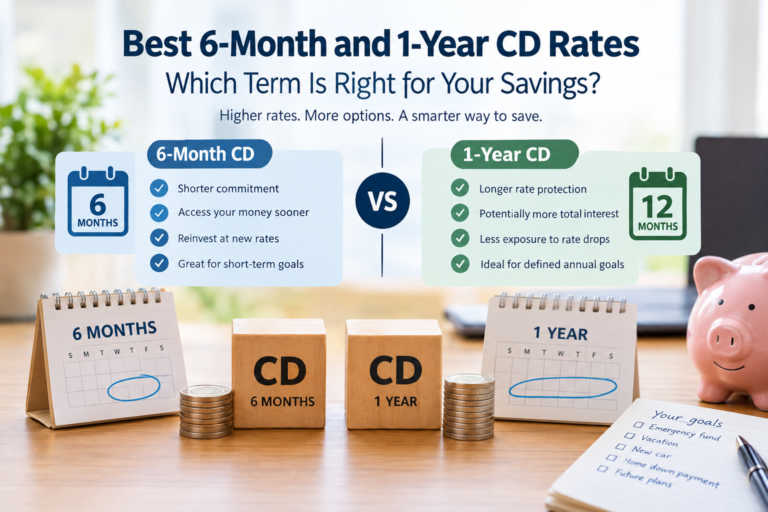
High-Yield Savings Accounts vs. CDs
Certificates of deposit can sometimes offer competitive interest rates, but they work differently.
With a CD, you generally agree to leave your money deposited for a predetermined period.
That could be several months, one year, two years or longer.
In return, the bank typically offers a fixed interest rate for the term.
The advantage is predictability.
The disadvantage is reduced liquidity.
If you need the money before the CD matures, you may face an early-withdrawal penalty.
A high-yield savings account generally provides easier access to your money.
For this reason, HYSAs can be particularly suitable for emergency funds or savings goals where the exact withdrawal date is uncertain. NerdWallet similarly notes that HYSAs can be more appropriate for emergency funds than CDs because the money generally remains accessible.
High-Yield Savings Accounts vs. Money Market Accounts
Money market accounts are another alternative.
They are deposit accounts that can offer competitive interest rates while sometimes providing additional features such as checks or debit-card access.
Forbes Advisor notes that money market accounts can offer rates comparable to savings accounts, although the specific requirements vary considerably between institutions.
The choice depends largely on how you intend to use the money.
Someone looking for a simple emergency fund may prefer an HYSA.
Someone who wants savings plus more transaction functionality may prefer a money market account.
High-Yield Savings Accounts vs. Investing
An HYSA should also not be confused with an investment account.
A savings account is primarily designed for:
- Capital preservation
- Liquidity
- Interest income
- Short-term savings
- Emergency funds
Investments such as stocks and equity funds are designed for longer-term growth but carry market risk.
The stock market can generate substantially higher returns over long periods, but losses can also occur.
Therefore, money that you may need in the short term generally serves a different purpose from money intended for long-term investment.
Who Should Consider a High-Yield Savings Account?
High-yield savings accounts can be particularly useful for people building an emergency fund.
An emergency fund is designed to cover unexpected expenses such as:
- Car repairs
- Medical bills
- Temporary loss of income
- Home repairs
- Emergency travel
- Other unexpected costs
Because emergencies are unpredictable, liquidity is important.
Keeping this money in a high-yield savings account allows it to remain relatively accessible while potentially generating interest.
They can also be useful for people saving toward a home purchase, wedding, vacation, tuition or other medium-term financial goals.
How Much Should You Keep in Savings?
There is no single amount that works for everyone.
The appropriate emergency-fund size depends on factors such as income stability, monthly expenses, debt, employment situation and household responsibilities.
A common framework is to build an emergency reserve covering several months of essential expenses.
For example, someone with $3,000 in essential monthly expenses might eventually target a reserve of $9,000 to $18,000 depending on their circumstances.
The important point is that the emergency fund should be designed around expenses and financial risk, rather than an arbitrary dollar amount.
The Importance of Liquidity
A high APY is of limited value if you cannot access your money when you need it.
Before opening an account, check how quickly transfers can be completed.
Some banks may allow fast transfers between linked accounts, while others may require additional processing time.
Also check whether:
- The bank offers mobile banking
- External transfers are supported
- There are transfer limits
- ACH transfers are free
- Same-day transfers are available
- Customer support is easily accessible
Liquidity can be particularly important during emergencies.
What to Look for When Comparing HYSAs
A useful comparison checklist should include at least seven factors.
1. APY
Look at the actual APY rather than simply the advertised interest rate.
2. Monthly fees
Ideally, avoid unnecessary maintenance fees.
3. Minimum balance
Check whether you need a certain amount to open the account or earn the advertised APY.
4. Rate conditions
Determine whether the highest APY requires direct deposits, a linked account or another qualifying activity.
5. Deposit insurance
Verify FDIC or NCUA coverage where applicable.
6. Accessibility
Consider transfer speeds, withdrawal procedures, mobile banking and customer support.
7. Rate stability
Remember that HYSAs normally have variable rates.
The Federal Reserve and Savings Rates in 2026
The Federal Reserve remains one of the most important institutions to watch if you hold cash in a high-yield savings account.
When the Fed changes its policy rate, banks may adjust the rates they offer depositors.
NerdWallet reported that several banks on its September list increased their savings rates after the Federal Reserve’s September rate hike. The institutions included American Express, Bask Bank, Bread Savings, Capital One, E*TRADE, Happen Bank, Ivy Bank, Marcus, SoFi, Synchrony, TAB Bank, Valley Bank and Vio Bank.
This demonstrates how closely the savings market can respond to monetary policy.
The next Federal Reserve announcement was scheduled for October 28, 2026, according to NerdWallet.
Savers therefore have another important event to watch as the fourth quarter begins.
Inflation Matters Too
A high savings rate does not automatically mean your money is gaining purchasing power.
Inflation reduces the purchasing power of money over time.
If your savings account earns 4% but inflation is also running at 4%, your approximate real return before taxes is close to zero.
If inflation is higher than your savings APY, the purchasing power of the money can still decline even though the account balance is increasing.
This is why savers should consider both:
Nominal return = APY
and
Real return ≈ APY − inflation
The calculation is simplified, but it demonstrates the basic concept.
Taxes on Savings Interest
Another factor that is sometimes overlooked is taxation.
Interest earned from a taxable savings account is generally considered taxable income in the United States.
Therefore, the amount you actually keep after taxes can be lower than the account’s advertised APY.
For example, earning $1,000 in interest does not necessarily mean you will have $1,000 of additional disposable income after taxes.
Your individual tax situation can vary considerably, so anyone making significant financial decisions should consider consulting a qualified tax professional.
Should You Move All Your Cash to the Highest-Yield Account?
Not necessarily.
The optimal setup can involve several different accounts.
For example, someone might keep:
Checking account:
Money for everyday spending and bills.
High-yield savings account:
Emergency fund and short-term savings.
CD:
Money that will not be needed for a predetermined period.
Investment account:
Long-term wealth-building capital.
Each account serves a different purpose.
Trying to maximize APY on every dollar can sometimes create unnecessary complexity or reduce liquidity.
A Practical Strategy for Choosing an HYSA in 2026
A simple process can make the decision easier.
Step 1: Determine how much cash you need
Calculate your emergency fund and short-term savings requirements.
Step 2: Decide how accessible the money needs to be
If you might need it immediately, prioritize liquidity.
Step 3: Compare APYs
Look at several institutions rather than relying on one comparison.
Step 4: Read the conditions
Check whether the advertised APY applies to your entire balance.
Step 5: Check fees
Make sure maintenance fees do not undermine the interest you expect to earn.
Step 6: Verify deposit insurance
Confirm that the institution provides the appropriate federal deposit insurance.
Step 7: Review the account periodically
Because rates change, the account that is competitive today may not remain competitive indefinitely.
The Bottom Line
The high-yield savings market in 2026 offers significantly better opportunities for savers than traditional low-interest savings accounts.
As of September 30, competitive HYSAs are offering rates around 4% APY, with some accounts reaching or exceeding 4.20% under specific conditions. Bankrate’s latest comparison listed Happen Bank and Western State Bank at 4.20%, while NerdWallet reported rates of up to 4.21% at Axos Bank when certain requirements are satisfied.
Other institutions, including CIT Bank, Vio Bank, Live Oak Bank, Newtek Bank, SoFi, Capital One and others, provide different combinations of interest rates, accessibility, fees and banking features.
The key lesson is that the highest APY is not automatically the best account for every saver.
A competitive savings account should offer a combination of a strong rate, low fees, reasonable requirements, reliable access to funds and appropriate deposit insurance.
For someone building an emergency fund or saving for a short- or medium-term goal, a high-yield savings account can provide a useful balance between earning interest and maintaining liquidity.
However, APYs are variable and can change as economic conditions and Federal Reserve policy evolve. The rates mentioned in this article reflect information available in September 2026 and should be checked directly with the financial institution before opening an account.
This article is for informational purposes only and does not constitute personalized financial, tax or investment advice. Account terms, APYs, fees, eligibility requirements and insurance coverage can change. Always review the current disclosures and terms provided by the financial institution before making a decision.