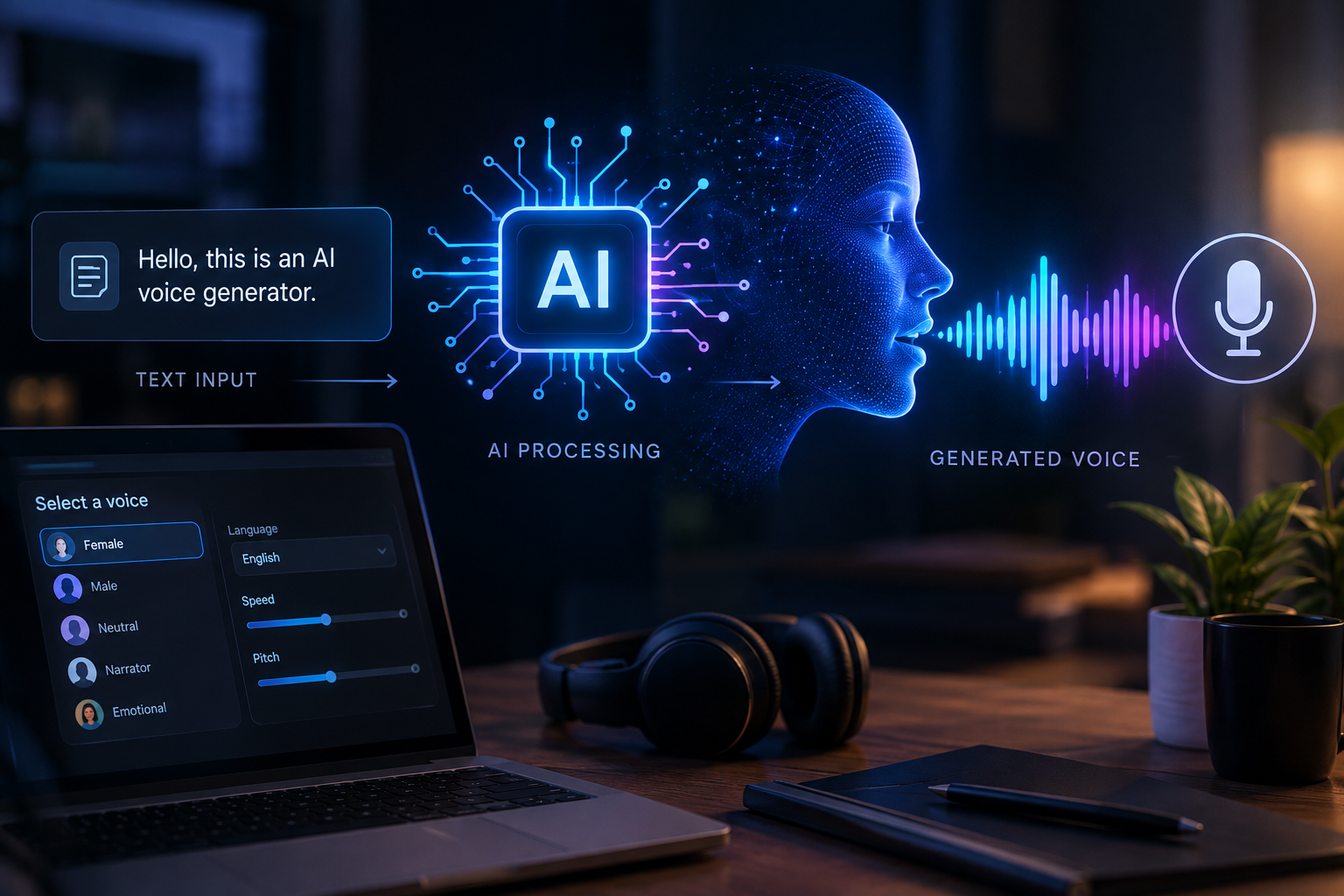
AI voice generators have changed dramatically in recent years. What was once a robotic-sounding technology used mainly for accessibility and automated phone systems has evolved into a powerful creative tool capable of producing remarkably natural speech.
Today, text-to-speech (TTS) platforms can generate voices for YouTube videos, podcasts, advertisements, audiobooks, online courses, social media content, video games, presentations, and business applications. Many services also offer multiple languages, accents, emotional styles, voice cloning, and tools for adjusting pacing and delivery.
With so many options available, choosing the right AI voice generator depends on what you actually need. Some platforms focus on extremely realistic voices, while others prioritize voice cloning, multilingual support, editing capabilities, or ease of use.
Below is a detailed look at the most important AI voice-generation platforms and what makes each one useful.
What Is an AI Voice Generator?
An AI voice generator is software that converts written text into spoken audio using artificial intelligence. Instead of recording a human narrator, you enter a script, select a voice, and generate an audio file.
Modern systems use advanced speech-synthesis models to reproduce characteristics of natural human speech, including pronunciation, rhythm, pauses, intonation, and emphasis.
The technology can be used for something as simple as reading an article aloud or as sophisticated as creating a complete voiceover for a commercial.
Many platforms now allow users to customize aspects such as:
- Voice style
- Speaking speed
- Pitch
- Pauses
- Pronunciation
- Emotional delivery
- Language and accent
- Voice intensity
Some services also allow users to create a digital version of a specific voice through voice cloning, although this feature comes with important consent and legal considerations.
1. ElevenLabs
ElevenLabs has become one of the best-known names in AI voice generation, particularly among content creators and developers who prioritize realistic speech.
Its technology is designed to produce highly natural voices with convincing pacing, intonation, and emotional expression. This makes it suitable for applications where listeners need to feel as though an actual person is speaking.
One of its major strengths is the large selection of voices available for different types of content. Users can also create customized voices and, where permitted, clone voices.
ElevenLabs supports multiple languages, making it particularly useful for creators producing content for international audiences.
Best for
- YouTube voiceovers
- Social media videos
- Audiobooks
- Podcasts
- Professional narration
- Multilingual content
- Developers building voice applications
Its main appeal is the balance between realism, customization, and professional-quality output.
2. OpenAI Text-to-Speech
OpenAI provides voice-generation technology designed for applications that need natural conversational speech. Its voice capabilities can be particularly useful when text-to-speech is combined with AI assistants and interactive applications.
Rather than simply converting long pieces of text into audio, modern AI voice systems can support dynamic conversations, making them useful for customer-service applications, educational tools, virtual assistants, and other interactive experiences.
For developers, the ability to integrate speech generation into software can be more important than having a traditional voiceover editor.
Best for
- AI applications
- Conversational assistants
- Software developers
- Interactive experiences
- Educational applications
- Real-time voice systems
The main advantage is the ability to combine speech generation with broader AI functionality rather than treating TTS as an isolated tool.
3. Google Cloud Text-to-Speech
Google Cloud Text-to-Speech is aimed primarily at businesses and developers who need scalable speech-generation technology.
The platform supports a wide variety of languages and voices and can be integrated into applications through Google’s cloud infrastructure.
This makes it useful for companies that need to generate large quantities of spoken content or provide speech capabilities inside their own applications.
For example, a company could use TTS to create automated customer-service responses, accessibility features, navigation systems, or educational applications.
Best for
- Businesses
- Developers
- Large-scale applications
- Accessibility tools
- Multilingual software
- Automated systems
It may be more technical than consumer-focused voice generators, but that flexibility is valuable for organizations building their own products.
4. Microsoft Azure AI Speech
Microsoft’s Azure AI Speech platform provides text-to-speech capabilities as part of its broader artificial intelligence and cloud ecosystem.
It offers numerous voices and languages and provides tools designed for developers and businesses.
One of its important strengths is customization. Developers can configure speech characteristics and integrate synthesized voices into applications and services.
Companies already using Microsoft Azure may find it particularly convenient because speech generation can be incorporated into their existing cloud infrastructure.
Best for
- Enterprise applications
- Developers
- Customer-service systems
- Accessibility
- Multilingual applications
- Businesses already using Azure
For individual creators, it may be more infrastructure than they need. For organizations, however, its scalability can be valuable.
5. Amazon Polly
Amazon Polly is Amazon Web Services’ text-to-speech platform.
It is primarily designed for developers and businesses that want to add speech capabilities to applications. Users can convert written text into natural-sounding speech and integrate the output into software using AWS infrastructure.
Polly can be used for applications such as news readers, e-learning platforms, automated customer-service systems, accessibility features, and voice-enabled products.
Best for
- Developers
- AWS users
- Business applications
- Automated narration
- Accessibility
- Large-scale systems
Its biggest advantage is its integration with the wider AWS ecosystem.
6. PlayHT
PlayHT is particularly popular with content creators looking for an accessible interface for producing AI voiceovers.
The platform provides a large selection of voices and languages and is designed around creating audio content without requiring extensive technical knowledge.
This makes it useful for creators who want to turn scripts into voiceovers for videos, advertisements, podcasts, or educational content.
Best for
- Content creators
- YouTube channels
- Marketing videos
- Podcasts
- E-learning
- Multilingual voiceovers
For creators who don’t want to build a technical TTS workflow, a dedicated platform such as PlayHT can be easier to use than a cloud developer API.
7. Murf AI
Murf AI focuses heavily on professional voiceovers and business content.
Its interface is designed to make voice production feel more like editing a presentation or video than programming an audio system.
Users can create narration for presentations, advertisements, explainer videos, training materials, and other business content.
A major benefit is the ability to edit the generated voiceover alongside the script, which can make it easier to adjust timing and create polished presentations.
Best for
- Presentations
- Corporate videos
- Advertisements
- Training courses
- Explainer videos
- Marketing teams
Murf is particularly interesting for businesses that need voiceovers regularly but don’t want to hire a narrator for every project.
8. Speechify
Speechify approaches text-to-speech from a slightly different perspective.
Rather than focusing exclusively on creators producing voiceovers, the platform is strongly associated with converting written material into spoken audio.
This can be useful for reading articles, documents, books, and other written content aloud.
The ability to listen rather than read can also make TTS useful for people who prefer consuming information through audio.
Best for
- Reading documents
- Articles
- Books
- Productivity
- Accessibility
- Listening while multitasking
Its focus makes it different from platforms primarily designed for creating commercial voiceovers.
9. Descript
Descript combines AI voice technology with a broader audio and video editing workflow.
One of its interesting features is that audio and video editing can be performed through text. This can make the production process considerably easier for creators who are accustomed to editing scripts rather than traditional audio waveforms.
AI voice features can also help creators produce or modify narration without recording every line manually.
Best for
- YouTube creators
- Podcasts
- Video editing
- Screen recordings
- Content production
- Script-based editing
For creators who need both voice generation and media editing, an integrated platform can be more convenient than using separate applications.
What Makes an AI Voice Generator Good?
Not all AI voices are equally convincing. Several factors determine whether a generated voice sounds professional.
1. Naturalness
The most important characteristic is how human the voice sounds.
A good system should reproduce natural pauses, emphasis, rhythm, and pronunciation rather than reading every sentence with identical intonation.
2. Voice Variety
A useful platform should provide different voices for different purposes.
A serious documentary may require a calm narrator, while an advertisement might need a more energetic delivery.
3. Language Support
If you produce international content, language support becomes extremely important.
Some platforms support dozens of languages and regional accents, while others focus primarily on English.
4. Customization
Advanced platforms allow users to control elements such as speed, pauses, pronunciation, and emotional delivery.
These controls can make a significant difference when producing professional narration.
5. Voice Cloning
Voice cloning allows AI to reproduce characteristics of a particular voice.
However, responsible use is essential. Users should only clone voices when they have the necessary permission and rights. Unauthorized imitation of another person’s voice can create legal, ethical, and reputational problems.
6. Audio Quality
Professional projects require clean audio without distracting artifacts, unnatural pronunciation, or inconsistent volume.
High-quality generated speech can often be used directly in videos, while lower-quality output may require additional editing.
AI Voice Generators for Different Use Cases
There isn’t one universally suitable tool for every project.
For YouTube videos, creators may prioritize realism, easy editing, and fast generation. Platforms such as ElevenLabs, Descript, and PlayHT can fit this type of workflow.
For business presentations, tools such as Murf can be useful because they combine narration with presentation-oriented workflows.
For developers, cloud platforms such as Google Cloud Text-to-Speech, Microsoft Azure AI Speech, and Amazon Polly provide APIs and infrastructure for integrating TTS into applications.
For AI assistants and conversational applications, speech systems designed around real-time interaction can be more appropriate than traditional voiceover generators.
For reading articles and documents, services such as Speechify are designed around listening to written content rather than producing commercial voiceovers.
Are AI Voices Better Than Human Voice Actors?
AI-generated voices and human narration serve different purposes.
AI has several practical advantages. It can produce speech quickly, generate multiple versions of the same script, and make changes without requiring a new recording session.
It can also be considerably more scalable for companies that need thousands of audio files.
Human voice actors, however, can provide authentic interpretation, personal character, improvisation, and emotional nuance that may be difficult for synthetic voices to reproduce consistently.
For a short social media advertisement, AI narration may be more than sufficient. For a major film, audiobook, or highly emotional campaign, human performance may still provide advantages.
The choice therefore depends on the project’s goals, budget, production schedule, and desired style.
The Future of AI Voice Generation
AI voice technology is developing rapidly.
Future systems are likely to become increasingly capable of controlling subtle elements of speech, including emotion, conversational timing, pronunciation, and personality.
Real-time speech generation is also becoming increasingly important. Instead of generating an audio file and playing it later, AI systems can produce speech during an ongoing conversation.
This could lead to more natural virtual assistants, customer-service agents, educational applications, games, and accessibility tools.
At the same time, the growth of voice cloning will make responsible use increasingly important. Authentication, consent, disclosure, and protections against impersonation will remain significant issues as synthetic voices become harder to distinguish from recordings of real people.
Final Thoughts
AI voice generators have evolved from simple robotic text readers into sophisticated platforms capable of producing highly realistic speech.
ElevenLabs is particularly focused on realistic creator-oriented voices, while OpenAI provides speech capabilities that can be integrated into conversational AI applications. Google Cloud, Microsoft Azure, and Amazon Polly are strong options for developers and businesses that need scalable APIs. Murf AI focuses heavily on professional voiceover production, while Speechify is oriented toward listening to written content and Descript combines AI voices with broader content-editing workflows.
The best choice ultimately depends on the type of content you want to create. A YouTube creator, software developer, business, podcaster, and student can have completely different requirements.
As synthetic speech continues to improve, AI voice generators are becoming an increasingly practical part of modern content creation, software development, accessibility, and digital communication.
Deja una respuesta